Deep Pashto Poetry by Ghani Khan About Love & Identity
In the ethereal embrace of the Pashto landscape, amidst the undulating hills and whispering winds, lies the soul of a poet, a bard who transcends the mundane—the illustrious Ghani Khan. His verses resonate with the cadence of love and the profound quest for identity, weaving a tapestry of longing and self-discovery that unfurls like a fragrant blossom at dawn. In the realm of deep Pashto poetry, Ghani Khan emerges as a luminary, illuminating the path of emotional exploration and existential musings.
To delve into the depths of Ghani Khan’s poetry is to embark on a journey where love intertwines with identity. Each stanza unfolds like a petal, revealing layers of passion, introspection, and a profound connection to one’s roots. Love, in his eloquent expressions, transcends the ephemeral, morphing into a sanctuary where souls unite and identities converge.
At the heart of his poetry lies a promise—a promise to illuminate the heart’s innermost corners, to confront the shadows of doubt, and to embrace one’s essence. In navigating the labyrinth of love, Ghani Khan imparts wisdom that shifts perspectives and nurtures curiosity, sparking a flame that beckons readers to reflect on their own identities and romantic entanglements.
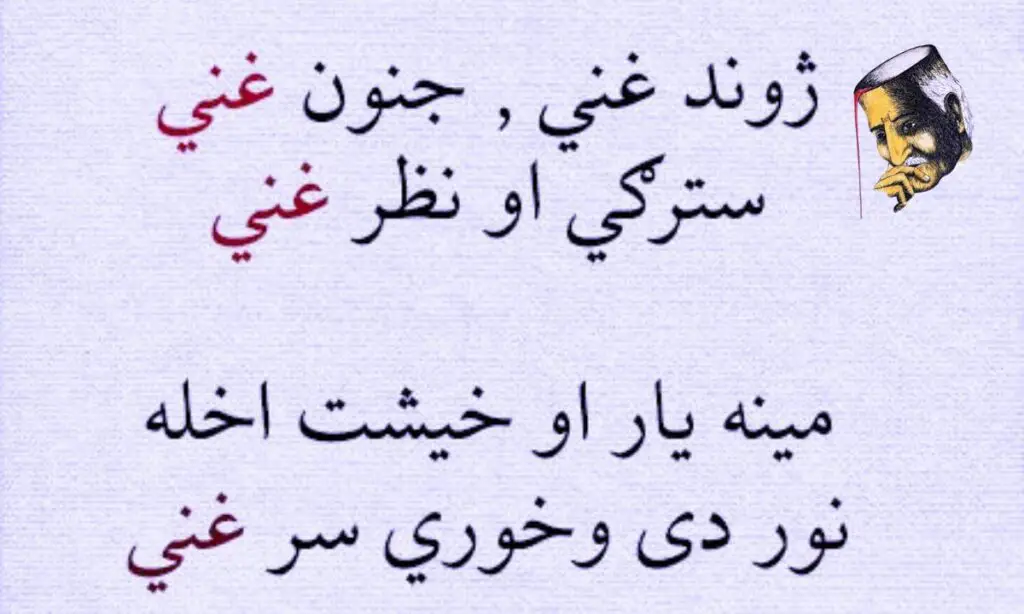
Consider the following verses, an echo of his lyrical brilliance:
In the garden of my heart, a rose blooms rare,
Petals whispered softly, drenched in dreams we share.
With each glance, a universe spins into view,
A tapestry woven of red and azure hue.Amidst the turmoil of yearning’s gentle strife,
Your laughter dances like the sun, enlivening life.
Together we traverse the mountains of despair,
Each promise whispered, a commitment laid bare.In the embrace of twilight, identity unfolds,
The stories of the soul, in verses untold.
So let us carve our names upon the stars above,
Bound by destiny, united in love.
Ghani Khan’s verses are a fusion of the external and the internal, a symphony that plays upon the heartstrings of love and identity. The garden he speaks of is not merely a physical space; it symbolizes the inner sanctum of our emotions, where the delicate interplay of passion and self-awareness comes to life. Herein lies the allure—his poetry invites readers to immerse themselves in the fragrant beauty of love while simultaneously unearthing the essence of who they truly are.
The exploration of love within Ghani Khan’s poetry often oscillates between unbridled joy and poignant longing. Love is presented as a transformative force, one that compels an individual to confront their vulnerabilities and embrace the multifaceted nature of existence. This journey, marked by a profound sense of authenticity, allows one to evolve, shedding the superficial layers that cloud one’s identity.
Moreover, as the themes of identity emerge, there is an intrinsic connection to one’s heritage, culture, and the very fabric of existence. Ghani Khan’s pen dances gracefully across the page, illuminating the notion that our identities are not singular but rather a mosaic crafted from the myriad experiences and relationships we cultivate throughout life. Each relationship, every moment of love and loss, contributes to this symphony of self.
Yet, amidst this lyrical exploration, lies a haunting question: What does it mean to truly belong? In the swirling maelstrom of modernity, where identities often feel fragmented or obscured, Ghani Khan’s poetry becomes a clarion call, urging us to reconnect with our roots. His verses remind us that love is not merely a transient emotion but a reaffirmation of our connection to the world, binding us to one another and to our true selves.
This love extends beyond mere romantic entanglements—it encompasses the love for one’s culture, community, and the undying spirit of resilience that courses through the veins of each Pashto speaker. Ghani Khan articulates this bond eloquently, weaving threads of cultural identity into the very fabric of his poetry. His evocative language resonates with those who find solace in the familiar and the cherished, offering a rekindling of pride in their heritage.
As we reflect on Ghani Khan’s expansive body of work, it becomes evident that the nexus of love and identity is a recurring motif that invites readers to contemplate their own significance within the tapestry of life. His poetry serves as a mirror, reflecting the joys and sorrows that accompany the human condition, ultimately leading us toward a deeper understanding of ourselves.
In conclusion, Ghani Khan’s deep Pashto poetry stands as a beacon of wisdom, an invitation to explore the intricacies of love and identity. Through his eloquent verses, he urges us to acknowledge our emotions, embrace our complexities, and reconnect with the essence of who we are. The promises embedded in his work spark curiosity, urging us to look within and to seek not only the answers to who we love but to whom we belong. In this beautiful interplay of words, lovers and dreamers alike may find solace and, perhaps, a profound awakening to their own identity.