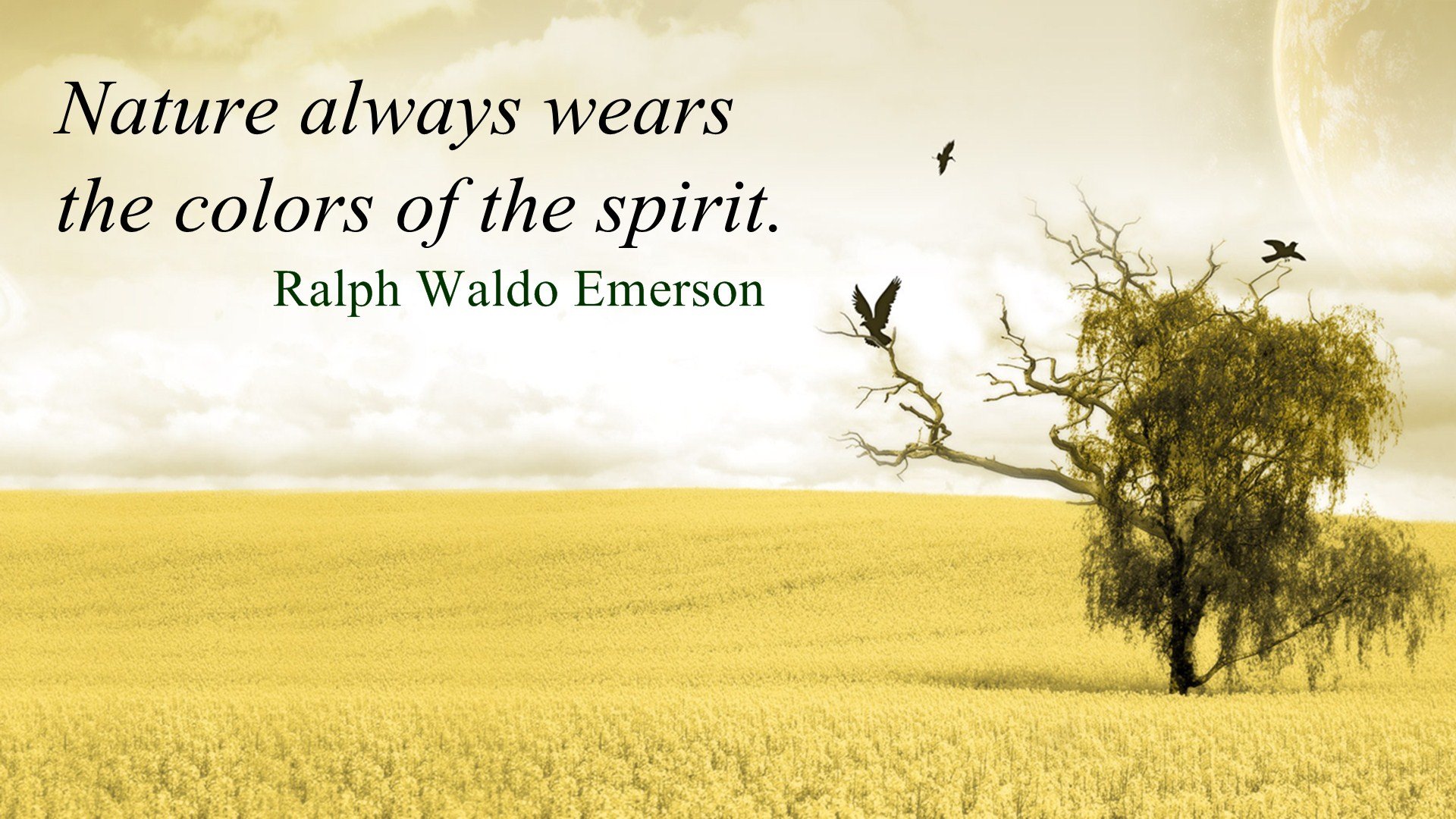
Nature & Philosophy in Poetry by Ralph Waldo Emerson
In the quietude of a dew-kissed dawn, when the world breathes gently awake, one finds resonances of Ralph Waldo Emerson’s profound thoughts on nature interwoven with the intricate tapestry of life. Emerson, a luminary of transcendentalism, artfully articulated the symbiotic relationship between the sublime beauty of the natural world and the depths of human philosophy—a dance immortalized in the cadence of his poetry.
In examining Emerson’s worldview, it is essential to traverse the pathways of his mind, revealing the philosophical undercurrents that flow through his verses. He perceived nature not merely as a backdrop for human endeavor but as an active participant in the drama of existence. In the embrace of verdant woods or the shimmering expanse of a starlit sky, he discovered the very essence of truth, the pulsing heartbeat of the universe.
Emerson’s nature was a living dialogue, a cacophony of whispers that beckoned the soul to listen and reflect. The apple blossoms in spring, the vibrant hues of autumn’s leaves, each element imparted wisdom. In this communion with nature, he implored humanity to awaken to the sublime, to unearth the profound insights that lie dormant in our surroundings.
Within the folds of his poetry, one can discern a hauntingly beautiful exploration of the individual spirit amidst the grandeur of the cosmos. Emerson urges us to recognize our connectivity to all that exists. The inner realms of our being resonate with the outer worlds of mountains, rivers, and skies—an enduring reminder that we are not isolated entities but rather integral threads in the vast tapestry of existence.
To encapsulate his philosophy, imagine a silken thread connecting the human heart to the heart of creation. In one of his most evocative verses, he encapsulates this sentiment with a radiant flourish. Here, the essence of his thoughts is distilled into a brief poem:
In the whispering woods where the shadows play,
And the sun weaves gold through the emerald spray,
I hear the murmurs of ancient lore,
The pulse of the earth—a boundless core.Each leaf that trembles, each branch that sways,
Speaks of existence in myriad ways.
Gaze on the stars, watch how they gleam,
A celestial canvas that inspires a dream.Oh, nature’s beauty, so raw and true,
In the quiet moments, I find my due.
For in the mountain’s grace and the river’s song,
I am reminded, in nature, I belong.
The poem captures the quintessence of Emerson’s philosophy, portraying a world in which nature speaks as eloquently as the most learned sage. This interplay of experience and introspection renders a sage invitation to humanity to engage with the world around them. Emerson believed that through such engagement, one could glean deeper truths about oneself and one’s place within the universe.
At the heart of Emerson’s philosophy lies the notion of self-reliance, an assertion so enduring that it continues to echo throughout the annals of literary thought. He encouraged individuals to eschew conformity and to embrace their intrinsic beliefs. Nature served as a mirror, reflecting both the majesty and fragility of humanity’s spirit. This philosophy of self-reliance invites a personal interaction with the grand and the minute, urging conformity to the self rather than to societal dictates.
When wandering through Emerson’s reflections, one becomes attuned to the rhythmic pulse of existence. He implores us to attune our senses, to listen to the subtle whispers of leaves rustling or the soft lullaby of a flowing stream. This attentiveness fosters a philosophy rooted in reverence—a reverence not only for nature but also for one’s innermost thoughts and feelings. Through these contemplations, one may encounter the sacred, the divine essence not just in nature’s expanse but also within the essence of the self.
The philosophical echoes of Emerson resonate within a broader existential inquiry, where the individual grapples with questions of purpose and belonging. Nature, as he described it, becomes a vital teacher, imparting spectral lessons through its cycles—birth, growth, decay, and renewal. These cycles mirror the human experience, intertwining our journeys with the eternal dance of life.
In a world that often hastens past the moments of quiet contemplation, Emerson’s reflections beckon us to pause. They implore us to understand that the answers to life’s profound queries often lie beneath the boughs of an ancient oak, in the ripples of a serene lake, or amidst the cacophony of a spring bloom.
His philosophical musings challenge us to redefine our expectations of the world. Rather than seeing nature as an inert canvas, Emerson guides our eyes to witness it as an animate partner, co-creator in the harmonies of existence. This concept reshapes our relationship with the Earth, fostering a sense of stewardship and reverence for the cycles that nurture life. Each moment spent in communion with nature becomes an affirmation of life, an embracing of both its joys and its tribulations, enriching our understanding of the interconnectedness of all beings.
In sum, Ralph Waldo Emerson’s intricate reflections on nature and philosophy in poetry champion the beauty of introspection, urging souls to tread lightly upon the Earth, listen deeply, and awaken to the harmonies that surround and envelop us. His is a call to find solace in the verdant embrace of the world, to forge an unbreakable link between one’s spirit and the universe’s enduring wisdom. In this eternal dialogue, we become both learners and teachers, as we navigate the extraordinary tapestry of life, woven together by the hands of time and nature itself.